
Whistleblower Response Plan
1. Purpose of the Response Plan
The Plan regulates the internal controls related to the steps of receiving, registering, analysing, investigating and processing disclosures received from Eligible Whistleblowers.
Capitalised terms used herein and not otherwise defined shall have the meaning assigned to them in the Policy.
2. Internal Whistleblower Process
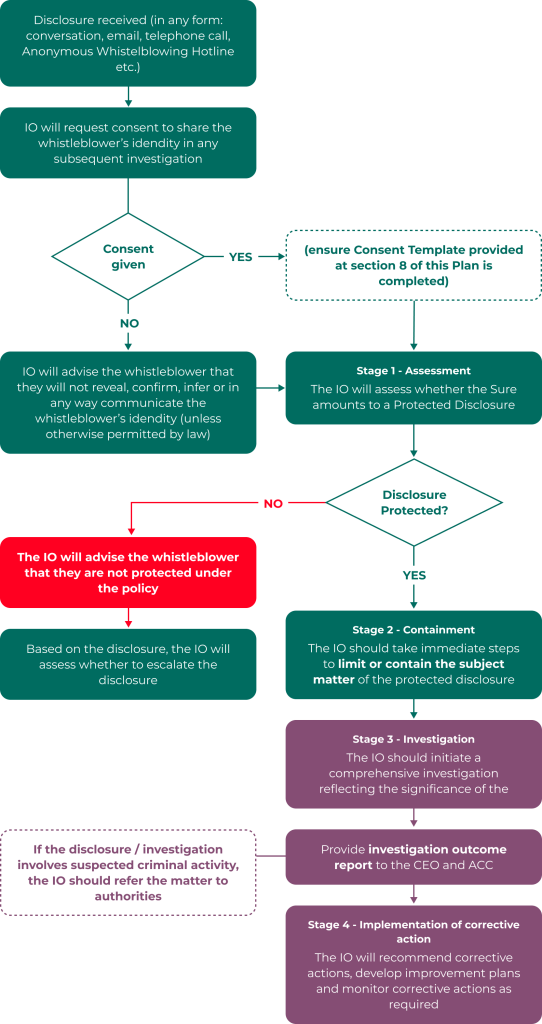
The steps below outline the process to be followed when a disclosure is received internally by an Eligible Recipient within Adica.
Note: The CRO is Adica’s authorised whistleblowing investigation officer who is responsible for assessing and formally investigating disclosures.
The Chief People Officer is Adica’s alternative whistleblowing investigation officer where a whistleblower does not consent for the disclosure to be investigated by the CRO, or where it is not appropriate for the CRO to investigate the matter (e.g. the CRO is mentioned within the disclosure).
For the purposes of this Plan the CRO and the Chief People Officer will be referred to as the Investigation Officer.
2.1 Initial identification and notification
The steps of this section will be followed immediately or as soon as practicable:
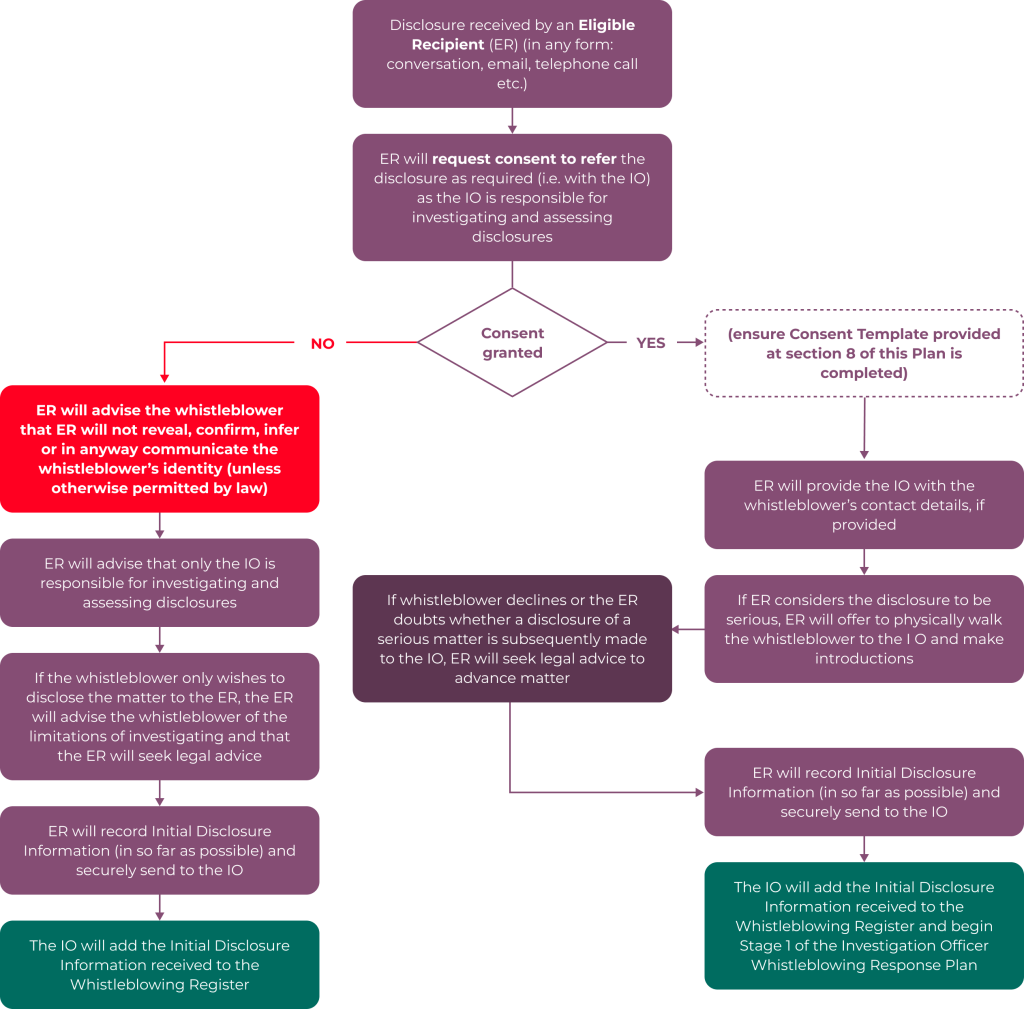
- If a disclosure is made to an Eligible Recipient, other than the Investigation Officer, the Eligible Recipient will request consent from the whistleblower to share their identity/disclosure as needed (to enable the Investigation Officer to investigate)
Note: If the whistleblower does not consent: the Eligible Recipient will advise the whistleblower of their right to remain anonymous, the Investigation Officer’s role in the process and of the limitations of being unable to refer the matter.
- The Investigation Officer will ascertain whether the whistleblower wishes to remain anonymous throughout the process;
- The Investigation Officer, by requesting further information (if required), will assess whether the whistleblower is an Eligible Whistleblower for the purposes of the Policy and whether their disclosure contains a Disclosable Matter and amounts to a Protected Disclosure under the Policy;
- In consideration of 3) above, the Investigation Officer will advise the whistleblower whether they are afforded protection under the Policy; and
- If the disclosure is not a Protected Disclosure, the Investigation Officer will, in consultation with the whistleblower, determine what (if any) further action should be taken in relation to the disclosure, taking into consideration and subject to Adica’s policies, procedures and obligations at law.
2.2 Containment of the subject of the disclosure
The steps outlined in this section will be followed in a timely manner:
- If the disclosure is a Protected Disclosure, the Investigation Officer should take immediate steps to limit or contain the subject matter of the Protected Disclosure without disclosing any information which could reveal the Eligible Whistleblower’s identity. Depending on the nature of the improper conduct, different actions may be required e.g. stop the improper conduct; recover any records etc.;
- The Investigation Officer should take measures to ensure the ability to investigate the disclosure is not compromised e.g. do not destroy evidence that may be valuable in determining the cause of the misconduct etc.; and
- The Investigation Officer should update the Eligible Whistleblower as to the progress of any investigation and anticipated timeframes, as appropriate. An Eligible Whistleblower may have made a disclosure on an anonymous basis (via the Anonymous Whistleblowing Hotline) and the Investigation Officer should attempt to agree a way of staying in contact which will preserve the anonymity of the Eligible Whistleblower, otherwise an investigation may be restricted or limited.
Note: In the process of determining whether a disclosure is a Protected Disclosure, or when containing the subject matter of a disclosure, the Investigation Officer must consider whether any relevant legislation, regulations or other Adica policies have been breached.
2.3 Investigation
The steps of this section will be followed in a timely manner:
- Each disclosure will be treated with due care and diligence and any subsequent investigation will reflect the significance of the disclosure (whether protected or otherwise);
- Throughout the investigation, the Investigation Officer (where appropriate) should:
- determine the root cause of the subject matter of the disclosure;
- if required, request the assistance of other staff members to facilitate the investigation provided the Eligible Whistleblower provides consent for their identity to be released to staff members (or alternatively, the Investigation Officer can maintain the anonymity of the Eligible Whistleblower by implementing processes including redacting any identifying features or using a pseudonym);
- identify whether the subject matter of the disclosure involves a systematic issue, an isolated incident or deliberate act;
- identify and gain agreement of appropriate actions to prevent the subject matter of the disclosure recurring or escalating to a more serious level where necessary, whilst fulfilling Adica’s obligations in relation to the anonymity of the Eligible Whistleblower; and
- maintain contact with the Eligible Whistleblower and advise of the progress of the investigation, subject always to fulfilling Adica’s obligations in relation to the anonymity of the Eligible Whistleblower; and
- The Investigation Officer will provide an investigation outcome, in the form of a written report, to the CEO and ACC, subject always to fulfilling Adica’s obligations in relation to the anonymity of the Eligible Whistleblower; and
- Where the Investigation Officer concludes that the disclosure involves criminal activity, the matter should be referred to the appropriate law enforcement agencies and authorities, subject always to fulfilling Adica’s obligations in relation to the anonymity of the Eligible Whistleblower.
2.4 Implementation of corrective action (if required)
The timeframe of this section will be as recommended or agreed:
- The Investigation Officer will identify corrective and/or preventative actions for implementation;
- The Investigation Officer will provide/agree target completion timelines for appropriate persons responsible;
- If a systemic issue is identified, an improvement plan should be developed to address policy/process improvement;
- An appropriate manager of those responsible for implementing corrective actions should undertake to ensure corrective actions are completed; and
- All steps above should be undertaken subject always to fulfilling Adica’s obligations in relation to the anonymity of the Eligible Whistleblower.
2.5 Reporting obligations
The Investigation Officer, as required by relevant reporting requirements in the ADJ Compliance Guidebook, may report disclosures, improper conduct and incident information to relevant senior management within specified timeframes, subject always to fulfilling Adica’s obligations in relation to the anonymity of Eligible Whistleblowers.
3. Whistleblowing Process
3.1 Eligible Recipient Whistleblowing Register obligations
If an Eligible Recipient (other than the Investigation Officer) receives a disclosure, the Eligible Recipient is responsible for recording the following information:
- consent from the whistleblower to share the matter as required (Yes/No);
- date consent/denial received;
- whether the whistleblower wishes to remain anonymous (Yes/No);
- name of whistleblower (if provided);
- contact information (if provided);
- format of disclosure (telephone call, email, letter etc.);
- summary of disclosure (brief summary of disclosure, ensuring that the details could not identify the individual, if requested)
The Eligible Recipient should then forward the Initial Disclosure Information to the Investigation Officer for addition to the Whistleblowing Register, subject always to fulfilling their obligations in relation to the anonymity of an Eligible Whistleblower.
3.2 Investigation Officer Whistleblowing Register obligations
If the Investigation Officer receives the disclosure, the Investigation Officer is responsible for recording the Initial Disclosure Information and adding it to the Whistleblowing Register.
If an Eligible Recipient (other than the Investigation Officer) receives a disclosure, the Investigation Officer is responsible for receiving the Initial Disclosure Information from the Eligible Recipient and adding it to the Whistleblowing Register.
If a whistleblower engages with the Investigation Officer to assess and investigate the subject matter, the Investigation Officer should update the Whistleblowing Register with the following information, as it becomes available:
- is the discloser an Eligible Whistleblower (Yes/No/Unknown);
- is the disclosure protected (Yes/No/Unknown);
- the date the whistleblower was advised of protection/unprotected;
- incident reported;
- significant (Yes/No);
- immediate action required;
- individuals involved;
- investigation log;
- corrective actions/timeframes; and
- outcome.
4. Roles and Responsibilities
| Roles | Responsibilities |
|---|---|
| CRO |
|
| Chief People Officer |
|
| Eligible Recipients |
|
| CEO and ACC |
|
5. Investigation Officer Whistleblower Response Plan
Notes:
- The Investigation Officer will update the Whistleblowing Register throughout the process above, where information becomes available.
- The Investigation Officer will maintain contact with the whistleblower throughout the process and advise of the progress of the investigation, subject always to fulfilling Adica’s obligations in elation to the anonymity of the Eligible Whistleblower.
6. Eligible Recipient Whistleblowing Response Plan
Notes:
Eligible Recipients will maintain their confidentiality obligations under the Adica Whistleblowing Policy and the Australian Whistleblowing Regime in relation to the anonymity of the Eligible Whistleblower.
Adica takes the protection of an Eligible Whistleblower’s identity seriously. To this end, the following matters should be considered with a view to controlling the risk of the whistleblower’s identity becoming known:
- Have you redacted relevant identifying materials?
- Where relevant, are you referring to the whistleblower in gender neutral terms or using pseudonyms?
- Are you disclosing information to individuals only on a need-to-know basis?
- Is the information you are disclosing absolutely necessary for the investigation?
- Have you ensured that any documents containing relevant information are password protected?
- Have you restricted user access to records and information?
- Is the investigation team as small as is reasonably possible?
- What other steps are you taking to ensure the investigation is as discrete as possible?
- Have you reminded all individuals involved in the investigation about the Confidentiality Obligation?